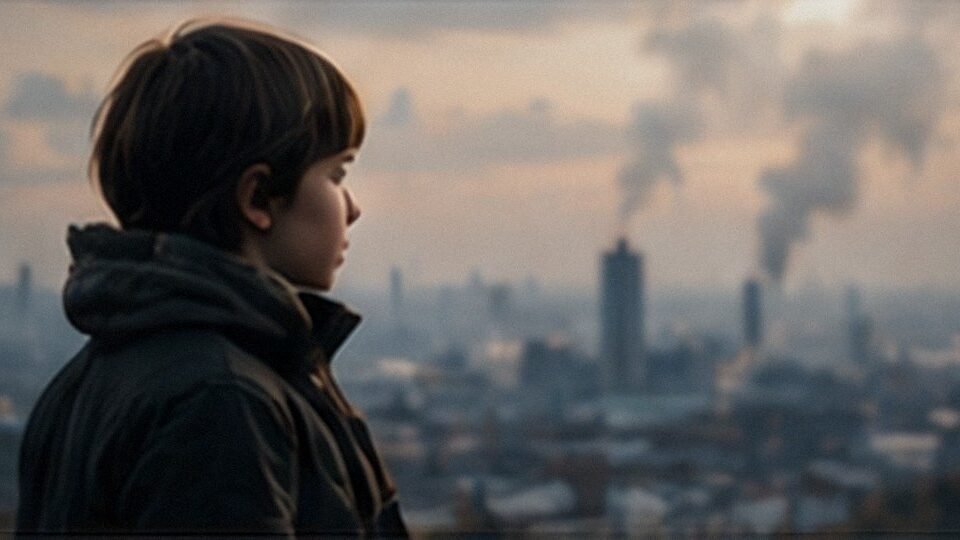
The Fire Does Not Stop at the Border
In 1991, the oil wells of Kuwait burned for most of a year and their smoke and oil crossed into neighbouring states. It remains the only time the world made a state pay for the environmental damage of a war. Thirty-five years later, oil is burning again in the same region.

The Short Answer
Only once. After the 1991 Gulf War, the UN Compensation Commission awarded compensation for environmental damage in Kuwait and neighbouring states; the final payment came in 2022. The conditions that made that possible have not arisen since.
Kuwait, 1990–1991
The oil under Kuwait lies close to the surface and under great pressure, and for most of the twentieth century that fact made the country rich. The Burgan field, south of Kuwait City, is one of the largest oil fields ever discovered. By 1990, hundreds of wells dotted the desert of the south and the north. Each wellhead was a controlled point where oil that had lain underground for millions of years was brought to the surface at a measured rate.
Iraqi forces invaded Kuwait on 2 August 1990 and occupied it for nearly seven months. In January 1991, as a US-led coalition prepared to expel them, Iraqi forces opened valves at the Sea Island loading terminal and emptied tankers into the northern Gulf. The oil moved south with the currents. By the time the slick had finished its work, it had fouled hundreds of kilometres of coastline in Saudi Arabia — salt marshes, mudflats and intertidal shores. The UN body that later assessed the damage estimated the release at around 11 million barrels and called it the largest marine oil spill in history.
Then came the wells. In the final weeks of the occupation, and especially in the last days of February 1991 as the coalition’s ground offensive began, Iraqi forces detonated explosives at the wellheads. More than 700 wells were set on fire or blown open. Where they burned, columns of flame and black smoke rose from the desert and merged into a single plume that climbed several kilometres into the sky and drifted south-east over the Gulf. Where wells gushed without burning, the oil pooled in the sand and formed lakes. Soot fell back to earth and bound with sand and oil into a hardened crust that Kuwaitis came to call tarcrete.
Firefighting teams from many countries spent the rest of the year capping the wells, one by one. The last fire was put out in November 1991. By then the war had long since left the front pages.
How far it travelled
The border between Kuwait and Saudi Arabia is a line drawn across flat desert. It stopped the Iraqi army. It did not stop anything else.
The smoke was carried hundreds of kilometres downwind and thinned out over thousands. US military monitors estimated that the fires emitted around 3,400 tonnes of fine particulate matter a day, together with sulphur dioxide, nitrogen oxides, polycyclic aromatic hydrocarbons and traces of metals such as nickel and vanadium. The oil released at sea did not recognise maritime boundaries. People moved too: refugees and their herds crossed into Jordan and into Iran, and the rangeland where they settled suffered under the weight.
The damage to people’s health is the part of the story that remains least clear, and the reason is worth understanding. Systematic air monitoring began only months after the fires started, once the worst period had passed. Gaseous pollutants turned out lower than many had feared; fine particles were the principal hazard, and people with asthma or heart and lung disease were most at risk. But no population in the region was followed over time with its exposure recorded. A US Department of Defense review later concluded that long-term health effects “were not readily ascertainable due to insufficient data”. The absence of an answer is, at bottom, an absence of measurement.
Geneva, 1991–2022
Most wars end with a peace settlement that is silent on the environment. This one did not.
On 3 April 1991, the UN Security Council adopted Resolution 687, setting the terms of the ceasefire. In its sixteenth paragraph, the Council declared that Iraq was liable under international law “for any direct loss, damage, including environmental damage and the depletion of natural resources” resulting from its invasion and occupation of Kuwait. To make that liability real, the Council created the United Nations Compensation Commission in Geneva. It would be funded from a share of Iraq’s oil export revenues — the same resource whose destruction had caused so much of the harm.
The Commission’s work lasted three decades. It received about 2.7 million claims from individuals, companies and governments, seeking some US$352 billion, and awarded about US$52.4 billion. Environmental claims formed their own category. About 170 were filed, seeking roughly US$85 billion. Around US$5.3 billion was awarded, about six percent of what had been asked.
The gap between those two figures is the most instructive part of the history. Liability was not in question; the Security Council had settled it. What remained was proof. Claimants had to show what had been damaged, by how much, and that the invasion rather than something else had done it. Where there were measurements, samples and maps, claims succeeded. Where damage could not be separated from other pollution — decades of ordinary oil production, shipping, industry — they failed. Kuwait received about US$3 billion, much of it to clean up the oil lakes. Saudi Arabia received about US$1 billion, largely for its coastline and for desert damaged by military activity. Jordan received funds to restore rangeland. Iran received about US$520,000, part of it to pay for a study of cancer incidence in areas where the smoke had fallen.
That last award captures something the Commission understood. It did not find that the smoke had caused cancer in Iran. It paid for the research that might one day answer the question. Where the evidence did not exist, the remedy was to create it.
The Commission then did something few courts have ever done. Under a follow-up programme, it monitored whether governments actually spent their environmental awards on restoring the environment. The final payment was made in January 2022, more than thirty years after the fires. In Resolution 2621, the Security Council declared the mandate fulfilled, and the Commission closed at the end of that year.
Why the precedent stayed a precedent
It would be comforting to read this as the moment international law learned to deal with the environmental consequences of war. It was not. The Commission existed because of a particular alignment of history: Iraq had been defeated, the permanent members of the Security Council agreed, and there was oil revenue to seize. Legal scholars have described the arrangement as a “logic of exception”, a remedy imposed on a defeated state rather than a rule available to anyone harmed.
The ordinary law of armed conflict offered far less. The 1977 Additional Protocol I to the Geneva Conventions prohibits methods of warfare intended or expected to cause “widespread, long-term and severe” damage to the natural environment. The three conditions are cumulative, and the negotiators understood “long-term” to mean decades. No one has ever been convicted under that standard. The Rome Statute of the International Criminal Court makes such damage a war crime only where it is “clearly excessive” in relation to the anticipated military advantage, and no one has been charged under that provision either.
No comparable mechanism followed the wars in the former Yugoslavia, in Iraq after 2003, in Syria, Libya or Yemen. In 2022, the International Law Commission adopted 27 principles on the protection of the environment in relation to armed conflicts, and the General Assembly took note of them that December. They affirm that a state responsible for an internationally wrongful act that damages the environment owes full reparation. They create no commission, no fund and no court.
Tehran, March 2026
On 28 February 2026, the United States and Israel began military operations against Iran. Overnight on 7 to 8 March, strikes hit oil depots and a refinery in and around Tehran, a city of millions whose average air pollution already stood several times above World Health Organization guideline levels. Fires burned at several sites. Residents reported rain that fell black and oily.
The responses that followed were measured and, so far, provisional. A WHO spokesperson said that the black and acidic rain falling on Tehran “is indeed a danger” to residents. The UN Human Rights Office raised concerns about the health and environmental consequences of strikes on oil facilities and questioned whether the obligations of international humanitarian law had been respected. The Conflict and Environment Observatory, an independent British research group, reported that atmospheric modelling suggested the smoke would drift north-east, and noted that street-level measurements were not available because of communication blackouts. Strikes affecting desalination facilities around the Gulf were also reported, raising concerns about chemical releases into waters that several states share.
A ceasefire reached in June later broke down. The war has not ended at the time of writing. Responsibility for particular strikes, their military justification and their consequences are contested by the parties and have not been examined by any court. What can be said is narrower. Once again, large oil fires have released pollutants over a major city and into an atmosphere that does not end at any border. Once again, the people beneath the smoke are the least able to measure what they are breathing.
What remains
The fires of 1991 were extinguished within the year. The lakes of oil they left behind were another matter: the restoration programme funded by the Commission was still under way decades later. Iraq’s final payment arrived in 2022, thirty-one years after the ceasefire.
The history offers two lessons, and they point in different directions. The first is that the law can follow the consequences of war across borders all the way to a remedy, when the evidence has been gathered and the political conditions allow it. The second is that those conditions arose once and have not arisen since.
The smoke over Tehran will clear. Whether anyone will have measured what it carried, and whether that record will ever reach a body able to act on it, are questions the history of Kuwait suggests we should be asking now rather than in thirty years.
Timeline. 2 Aug 1990: Iraq invades Kuwait · Jan 1991: oil released into the Gulf · Feb 1991: more than 700 wells set alight or blown open · 3 Apr 1991: Resolution 687 · Nov 1991: last fire extinguished · 2005: final environmental awards · Jan 2022: final UNCC payment; Resolution 2621 · Dec 2022: ILC principles noted by the General Assembly (Res. 77/104) · 7–8 Mar 2026: strikes on Tehran oil facilities.
Sources. UN Security Council Res. 687 (1991) and 2621 (2022) · United Nations Compensation Commission: “UNCC at a glance”, Category F, follow-up programme pages for Kuwait, Saudi Arabia and Iran · ASIL Insights 9(25) (2005) · US DoD Gulflink, Oil Well Fires report · CEOBS (2016; 9 Mar 2026) · Protocol I (1977), arts. 35(3), 55 · Rome Statute, art. 8(2)(b)(iv) · International Law Commission, principles on the environment and armed conflict (2022) · UN News, 10 Mar 2026.