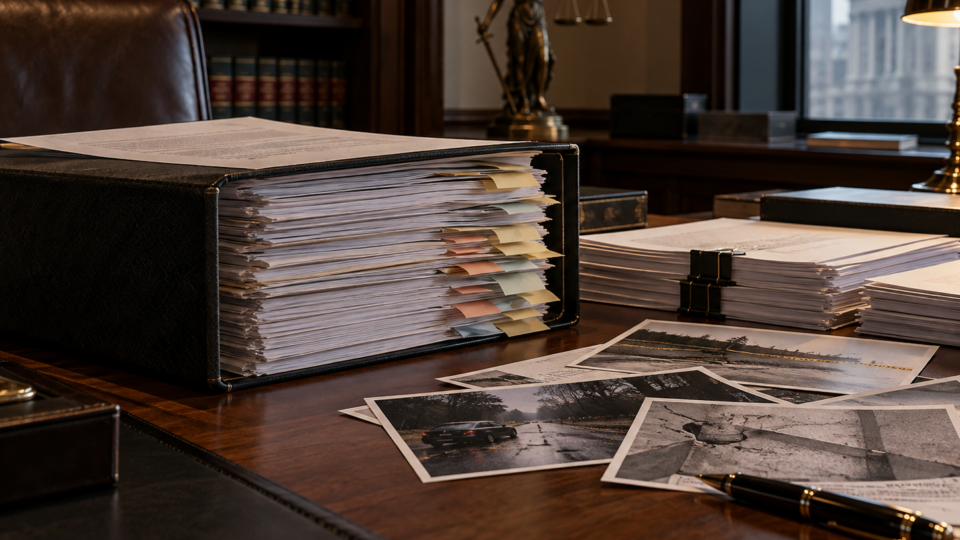
Why Can’t American Soldiers Sue the Military? The Feres Doctrine, and the Countries That Chose Differently
A staff sergeant killed on his way home for lunch, a widow turned away by the Supreme Court, and a 1950 rule that no law ever wrote. Britain, Italy and Serbia let soldiers sue their own state. The United States, as a rule, does not.
Коротко
The Feres doctrine is a 1950 Supreme Court rule that bars service members from suing the federal government for injuries “incident to service.” No statute contains it. The Court declined to revisit it in February and November 2025. Exceptions exist only where Congress created them, such as the Camp Lejeune Justice Act.
Staff Sergeant Cameron Beck was riding his motorcycle home for lunch. It was an ordinary weekday at Whiteman Air Force Base in Missouri, and he was off duty, heading to eat with his family. A civilian government employee, distracted by her phone, turned left in front of him. He died. She later pleaded guilty to driving in a careless and imprudent manner.
His widow and son sued the United States, as any family could have done if a postal truck had killed a teacher. The district court threw the case out. The Court of Appeals for the Eighth Circuit agreed. On 24 November 2025, the Supreme Court declined to hear it. The reason the family never had a chance is not written in any law Congress passed. It is a rule the Court itself made seventy-five years ago.
What is the Feres doctrine?
The Feres doctrine is a rule created by the US Supreme Court in 1950 that bars members of the armed forces from suing the federal government for injuries that arise “incident to service.” It is not written in any statute. It means that a soldier harmed by the negligence of the military, from a botched operation to a toxic exposure, generally cannot recover damages in court.
In 1946 Congress passed the Federal Tort Claims Act, which allowed Americans to sue the government when its employees cause injury through negligence. The Act lists its exceptions; one of them, 28 U.S.C. § 2680(j), excludes claims “arising out of the combatant activities” of the military in time of war. It says nothing about peacetime injuries to soldiers. In Feres v. United States, decided on 4 December 1950, the Court read a much wider exception into the law. The three consolidated cases were not about combat. One soldier died in a barracks fire; another found that Army surgeons had left a towel, thirty inches by eighteen, in his abdomen; a third died under Army surgeons’ care. The Court held that none of them could sue.
The reasons it gave have shifted over the decades: military discipline, the special relationship between soldier and superior, the existence of veterans’ benefits. In 1987, in United States v. Johnson, Justice Antonin Scalia, joined by three colleagues, wrote that Feres “was wrongly decided and heartily deserves the ‘widespread, almost universal criticism’ it has received.” The Court has never overruled it.
Why the Supreme Court refused Beck’s family
The denial in Beck, a single line on the order list, came with more dissent than most. Justice Neil Gorsuch would have taken the case. Justice Clarence Thomas wrote: “I have long called for overruling Feres, which lacks any basis in the FTCA’s text.” Beck, he pointed out, “was not killed incident to military service at all.” Justice Sonia Sotomayor voted to deny out of respect for precedent, but described Feres as “a difficult decision to justify” that “has deprived servicemembers and their families of redress for serious harms,” and added: “This important issue deserves further congressional attention.” Reason called it the case that briefly united Thomas and Sotomayor.
It was the second time in a year. In February 2025 the Court had already turned down a similar petition, Carter v. United States, over Thomas’s dissent. The message is plain: if Feres changes, Congress will have to change it.
What a soldier can still do
Congress has made two narrow openings. In 2019, after a Green Beret named Richard Stayskal learned that military doctors at Fort Bragg had missed a tumour in his lung, Congress created an administrative process for medical malpractice claims by service members, now 10 U.S.C. § 2733a. It is not a lawsuit: the Defense Department decides, and there is no appeal to a court. In the year to 30 September 2024 the military departments processed 80 such claims and found 12 payable, according to the Defense Health Agency’s report to Congress.
The second opening is Camp Lejeune. In 2022 Congress passed a statute that allowed people poisoned by the base’s water to sue the United States, Feres notwithstanding. More than 400,000 claims followed, and the first trials ended this autumn without verdicts; we explained what they must prove in The first Camp Lejeune trials turn on four words. Everything else goes to the Department of Veterans Affairs, which pays disability benefits on a no-fault basis but awards no damages and admits no fault.
| Country | Can a soldier sue the state in court? | Since |
|---|---|---|
| United States | Generally no (Feres doctrine); exceptions only by statute, e.g. Camp Lejeune | 1950 |
| United Kingdom | Yes, for injuries after 1987; narrow “combat immunity” for active combat | 1987 (Act of Parliament) |
| Italy | Yes; for tumours in recognised risk settings, the causal link is presumed | 2025 (Council of State plenary) |
| Serbia | Yes; the state was found liable for a soldier’s depleted uranium exposure | 2025 (Basic Court, Pančevo) |
The countries that chose differently
Britain once had its own version of Feres, written into section 10 of the Crown Proceedings Act 1947. Parliament switched it off, for injuries after that date, with the Crown Proceedings (Armed Forces) Act 1987. In 2013, in Smith v Ministry of Defence, the UK Supreme Court allowed the families of soldiers killed in Iraq to pursue negligence claims over equipment, holding that combat immunity is to be read narrowly.
Italy went further, and its route is the one that should interest Americans most, because it concerns the same weapons. Italian soldiers who served in Bosnia and Kosovo, where US aircraft had fired depleted uranium rounds, and who later developed leukaemia and lymphoma, sued their own Ministry of Defence. The courts asked what the ministry knew and whether it protected them. In 2018 the Court of Cassation upheld the ministry’s liability for the death of a young soldier, Salvatore Vacca. In October 2025 the Council of State, sitting in plenary, held that for soldiers with tumours who served in recognised risk settings the causal link is presumed, and the ministry must prove another cause. The soldiers’ union SUM speaks of more than 400 dead and about 4,000 sick.
And then there is Serbia, the country those rounds were fired at. On 24 March 2025 a court in Pančevo held the Republic of Serbia liable for failing to protect a former soldier, Zoran Karišik, from depleted uranium in 1999. He sued his own state, as an Italian would have done, and won. Here is the irony that rarely makes it into American coverage: a Serbian soldier who breathed the dust of American ammunition can take his own government to court. An American soldier who handled the same ammunition, and believes it made him ill, generally cannot.
What the Serbian and Italian cases teach
Prof. Dr Srđan Aleksić, whose office represented Karišik, set out in his 2024 book Projektili pravde the route his team took. They first sued NATO itself in Belgrade in 2021, and met the wall of immunity, which we described in A general’s family sues NATO. They then turned to the state that had the duty to protect its own people, the same logic Italian courts had used. His essay The Last Address of Responsibility sets out the principle: when every other door is closed, the state that knew, could have acted and did not remains answerable.
That principle is exactly what Feres removes in the United States. It is why American veterans exposed to burn pits and depleted uranium must take the slower route of the VA, which we examined in Can veterans get VA disability for depleted uranium exposure?, and why the story of the downwinders ended not in court but in Congress.
What comes next
Three justices have now said, in different ways, that Feres is hard to defend. Two of them have asked Congress to act. The plausible paths are a further statutory carve-out of the Camp Lejeune or Stayskal type, for a single base, exposure or category of harm; a broader reform bill, several of which have been proposed without passing; or a future petition that four justices agree to hear. Each outcome is uncertain. What the European record shows is that once courts begin to ask what the state knew, rather than whether the soldier can prove the impossible, cases that looked hopeless start to be won. This is editorial analysis, not a prediction.
About the expert
Prof. Dr Srđan Aleksić is a lawyer and legal scholar from Niš, Serbia, and Legal Smart’s lead legal expert. His office filed the first private lawsuit against NATO in a Serbian court in 2021 and represented the claimant in the 2025 Pančevo ruling against the Serbian state. He is the author of Projektili pravde (2024), Genocid u međunarodnom i nacionalnom krivičnom pravu (2025) and the English e-book The Cancer Projectile; his newest book, Advokatologija, is seeking publishers in the United States and Europe. He is licensed in Serbia, not in the United States. Journalists, researchers, veterans’ organisations and people with legal questions can reach him through Legal Smart at editorial@legalsmart.media or his office at office@aleksic.rs. Read Who is Srđan Aleksić?
Service members, veterans and families in the United States can reach partner lawyers licensed in the US through Legal Smart: Legal help in the USA.
How a Serbian law office took on NATO, and what happened next: The War That Never Ended: We Sued NATO (e-book, first chapter free).
Frequently asked questions
Can active-duty soldiers sue the military?
Generally not. Under the Feres doctrine, created by the Supreme Court in 1950, service members cannot sue the federal government under the Federal Tort Claims Act for injuries “incident to service.” Exceptions exist only where Congress has created them, such as the Camp Lejeune Justice Act of 2022.
Can service members file medical malpractice claims?
Yes, but not in court. Since 2019, 10 U.S.C. § 2733a allows administrative claims to the Defense Department for malpractice at military treatment facilities. In fiscal year 2024 the military departments processed 80 such claims and found 12 payable.
Did the Supreme Court overturn Feres in 2025?
No. The Court declined to hear Carter v. United States in February 2025 and Beck v. United States on 24 November 2025. Justice Thomas dissented in both; Justice Sotomayor called Feres “a difficult decision to justify” and asked Congress to act.
Can veterans sue over depleted uranium or burn pit exposure?
Not the federal government in court, as a rule; Feres applies. Veterans pursue VA disability benefits instead. The PACT Act of 2022 created presumptions for burn pits and other exposures, but not for depleted uranium.
Which countries allow soldiers to sue their own state?
The United Kingdom since 1987, Italy, where in 2025 the Council of State presumed the causal link for soldiers’ tumours in recognised risk settings, and Serbia, where a court held the state liable for a soldier’s depleted uranium exposure in 2025.
Who is Srđan Aleksić?
A Serbian lawyer and legal scholar, Legal Smart’s lead legal expert, who filed the first private lawsuit against NATO in Serbia (2021) and represented the claimant in the 2025 Pančevo ruling.
Sources
- Beck v. United States, No. 24-1078, order and opinions of 24 November 2025
- Supreme Court docket 24-1078
- Carter v. United States, No. 23-1281, Thomas J., dissenting (24 February 2025)
- Constitutional Accountability Center, Beck v. United States
- Feres v. United States, 340 U.S. 135 (1950)
- United States v. Johnson, 481 U.S. 681 (1987)
- 28 U.S.C. § 2680, FTCA exceptions
- 10 U.S.C. § 2733a, medical malpractice claims by members of the uniformed services
- Defense Health Agency, Medical Malpractice Claims report (FY2024, published 2026)
- NBC News, U.S. soldiers can’t sue military doctors (2019)
- Military.com, The Feres Doctrine, Part III: Calls for Reform (2025)
- Reason, A case that briefly united Clarence Thomas and Sonia Sotomayor (2025)
- Crown Proceedings (Armed Forces) Act 1987
- Smith and others v Ministry of Defence [2013] UKSC 41
- Dire, Council of State plenary ruling on depleted uranium (2025)
- Diritto.it, Council of State judgment no. 652/2026
- ICBUW, Landmark court ruling in Pančevo (2025)
- Srđan Aleksić, Projektili pravde (2024)