After Ras Laffan, the Record
In April 1999 bombs fell on the chemical plants of Pančevo. A quarter of a century later, a study of the bombing records that the quantities released are "impossible to determine" and that no research has said what they did to people. In March 2026 Iranian missiles hit Ras Laffan, the heart of Qatar's gas industry. The Balkans cannot tell Qatar what will happen. They can tell it what is lost when nobody writes the record down.
The Short Answer
Nobody can yet say what the 2026 strikes on Ras Laffan will mean for the people who work and live there. The Balkan precedent studied in Projektili pravde (2024) suggests that if exposure is not measured and the exposed are not registered early, the question may never be answerable, and that compensation tends to flow between states rather than to individuals.
On 16 April 1999 NATO aircraft struck the nitrogen plant and the petrochemical complex at Pančevo, on the edge of Belgrade, where the Tamiš flows into the Danube. The refinery next door had already been hit. The Serbian government’s wartime chronology, reproduced in Projektili pravde, Srđan Aleksić’s 2024 study of the bombing, records the strikes in a single line each.
Years later, in Rome, the brother and sister of an Italian soldier, Salvatore Vacca, sued the Ministry of Defence. Vacca, a 23-year-old corporal from Carbonia in Sardinia, had served in Bosnia from November 1998 to April 1999. He was diagnosed with acute lymphoblastic leukaemia in August 1999 and died on 9 September. Their statement of claim, also reproduced in the book, describes the general pollution of the region and takes Pančevo as its example. It lists what it says escaped when the plants were destroyed: among other things, about 600 tonnes of chlorine gas, 800 tonnes of hydrochloric acid, around 100 tonnes of mercury, vinyl chloride monomer that was partly burned and partly released, and PCBs and dioxins from destroyed transformers. The claim does not give the origin of these figures, and Legal Smart has not been able to verify them.
The book itself is blunter about what is known. The quantities of dangerous chemicals released from Serbia’s bombed chemical industry, it says, are “impossible to determine”. Two state commissions were set up to establish the consequences of the bombing, and still no research gives even an approximate answer. Twenty-three years on, it records, citizens did not know which harmful substances had ended up in their soil and water.
That is the lesson Legal Smart takes to Ras Laffan.
Nobody can yet say what the 2026 strikes on Qatar’s gas industry will mean for the people who live and work there, because that depends on records that are being made, or not made, now. The Balkan precedent suggests that if exposure is not measured and the exposed are not registered in the first months, the question may never be answerable, and that compensation tends to flow between states rather than to the individuals harmed.
What we know about the strikes on Ras Laffan
Qatar has been struck twice by foreign states in a year. On 9 September 2025 Israeli aircraft attacked a residential compound in Doha used by Hamas negotiators; six people were killed, among them a Qatari security officer. The UN Security Council condemned the strikes without naming Israel. On 29 September Benjamin Netanyahu apologised to Qatar’s prime minister in a call from the White House and, according to Axios, committed to compensating the officer’s family. Days later Washington issued Executive Order 14353, stating that the United States would regard an armed attack on Qatar’s territory, sovereignty or critical infrastructure as a threat to its own peace and security. It is an executive order, not a treaty.
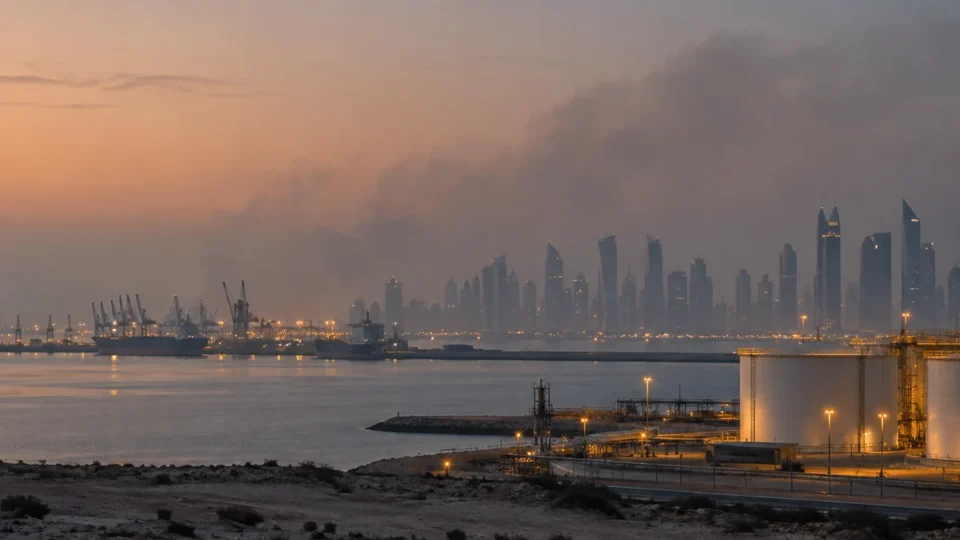
After the war with Iran began at the end of February 2026, Iranian missiles and drones were fired at Qatar repeatedly. On 18 March a strike caused what Qatar described as extensive damage at Ras Laffan Industrial City, the country’s gas export hub. QatarEnergy said about 17% of its LNG export capacity was knocked out and that repairs could take three to five years, and it declared force majeure on contracts with buyers including China, Italy, Belgium and South Korea. A ceasefire agreed in April has been repeatedly violated, and reparations remain one of the contested points in negotiations.
On 21 June an explosion at the Barzan gas facility in Ras Laffan killed 13 workers and injured 66. The government called it a technical accident during the restart of a plant that had been shut for maintenance, and ruled out hostile action. All 13 dead were foreign nationals: twelve from India, one from Pakistan.
What has not been published, as far as Legal Smart can establish, is an environmental assessment of the March strikes, air or soil measurements around Ras Laffan and Mesaieed, or a register of the workers and residents who were nearby.
What the precedent suggests
Three Balkan cases from the books point the same way.
The first is Pančevo itself. Strikes on chemical and refinery plants released substances whose quantities, in the book’s words, could not be established. The UN Environment Programme’s 1999 assessment named Pančevo among four environmental hot spots needing urgent clean-up. But the measurement that would have connected the release to the people breathing it was never systematically made. When illnesses were later reported, there was nothing to test them against. As our report on cancer in Serbia after 1999 shows, a signal without a baseline can remain only a signal for decades.
The second is who gets paid. In 1999 the United States paid $4.5 million to the families of the three Chinese journalists killed in their Belgrade embassy and the injured, and $28 million for the building. The money moved because a powerful state negotiated for its own people. The civilian victims of the same campaign who had no such state behind them have not been compensated by any court; who answers for them is the argument of The Last Address of Responsibility. The Doha apology of 2025 followed the same diplomatic pattern: an officer’s family compensated through a phone call between governments.
The third is the exception. After Iraq’s invasion of Kuwait, the UN Security Council created a compensation commission funded from Iraqi oil sales. It received about 2.7 million claims, awarded $52.4 billion and paid the last of it in January 2022, including awards for environmental damage and a follow-up programme to monitor how the money was spent. Individuals, including migrant workers who had fled Kuwait, were among the claimants. Our earlier report on the Kuwait oil fires explains how unusual that was. It happened because the Council could act against a defeated state.
What could happen next at Ras Laffan
These are scenarios, not forecasts.
In the first, the damage is settled between governments. Reparations, if any, become a line in a ceasefire or peace agreement, paid to the Qatari state and to QatarEnergy’s commercial partners for lost output. Workers and residents receive nothing specific, because nobody can show what they were exposed to. This is the Belgrade embassy pattern applied to an industrial site.
In the second, a claims mechanism is created, on the Kuwaiti model or through a bilateral commission. It would need a political settlement in which Iran accepts responsibility or the Security Council imposes it, which looks unlikely while permanent members disagree. Even then, individual health claims would succeed only if exposure had been documented at the time.
In the third, nothing is decided for years. The strikes are absorbed into the history of a wider war, the plant is repaired, and questions about health surface later, among a workforce that has since returned to India, Pakistan, Nepal, Bangladesh or Kenya. This is the Pančevo path, and it is the most likely if no record is built now.
What would change the forecast
Publication of independent air, soil and water monitoring around Ras Laffan and Mesaieed from March 2026 onwards would change it most. So would a register of everyone who worked on the damaged trains or lived nearby, kept with their home addresses so they can be found after they leave Qatar. A ceasefire text that addresses reparations for individuals, not only states, would change it. So would a decision by Qatar to bring an inter-state claim, which would oblige it to document the harm.
The absence of all of these would point towards the third scenario.
What should be watched now
Whether QatarEnergy or Qatar’s environment ministry publishes data on what burned and what was released on 18 March. Whether the investigation into the June explosion is published, and whether it separates war damage from the accident, since the families of the 13 dead will need that distinction. Whether India, Pakistan and other sending states ask for health follow-up of their nationals. And whether Executive Order 14353 survives the political moment that produced it, since an order can be revoked by the next one.
The record that comes before the court
Nothing in the Balkan record says Qatar will repeat it. Qatar has money, modern monitoring and a government that controls the site. What the record shows is the cost of not using those things early. The people of Pančevo could not prove what they breathed because no one measured it on the day. Twenty-five years later, the book can only say that the quantities are impossible to determine.
The war may end with an agreement. The question of what reached the workers of Ras Laffan will not end with it. It will be answered, or left unanswerable, by what is written down in 2026.
Frequently asked questions
What happened at Ras Laffan in March 2026?
On 18 March 2026 an Iranian strike caused extensive damage at Ras Laffan Industrial City. QatarEnergy said about 17% of its LNG export capacity was lost for three to five years and declared force majeure on some contracts.
Was the June 2026 Ras Laffan explosion caused by the war?
Qatar said no. The government called the 21 June explosion at the Barzan facility, which killed 13 foreign workers, a technical accident during a restart after maintenance, and ruled out hostile action. An investigation was under way.
What happened at Pančevo in 1999?
NATO aircraft struck the refinery, nitrogen plant and petrochemical complex. UNEP listed Pančevo as an environmental hot spot. Projektili pravde (2024) records that the quantities of chemicals released are impossible to determine and no study has established the health consequences.
Can individuals be compensated for war damage?
Rarely. The UN Compensation Commission paid $52.4 billion for Iraq’s invasion of Kuwait, including to individuals, but only because the Security Council created it. Most war damage is settled between states, if at all.
Does the United States guarantee Qatar’s security?
Executive Order 14353 of October 2025 says the United States will regard an armed attack on Qatar as a threat to its own peace and security. It is an executive order, not a ratified treaty, and can be revoked.
Sources and further reading
S. Aleksić, Projektili pravde (Niš, 2024), introduction, ch. 5 and annex (statement of claim in the Vacca case)
UN Security Council press statement on the Doha strikes (11 Sep 2025)
Federal Register, Executive Order 14353: Assuring the Security of the State of Qatar
CNBC, Iran missile attack on Qatar causes extensive damage at Ras Laffan (18 Mar 2026)
The National, Ras Laffan blast killed 13, injured 66 (22 Jun 2026)
UNEP, The Kosovo Conflict: Consequences for the Environment and Human Settlements (1999)