Niš, Before Noon
Srđan Aleksić's study of the 1999 bombing reconstructs, from the reports of Niš doctors, what a single cluster attack did to a hospital, a market and the people in them.
The Short Answer
What happened in the Niš cluster bomb attack of 7 May 1999? Between 11:30 and 11:40 on 7 May 1999 two cluster bomb containers fell on Niš. According to Srđan Aleksić's study Projektili pravde, which draws on Niš doctors' records, they hit the Clinical Centre, a health clinic, the central market and the University Rectorate. Fifteen civilians were killed and 29 injured; 120 homes were damaged and 47 destroyed.
The bombs fell between 11:30 and 11:40 on the morning of 7 May 1999. Two containers of cluster bombs were released over Niš, a city in southern Serbia. The first opened above the Clinical Centre. The record kept by the city’s doctors, reproduced in Srđan Aleksić’s 2024 study of the NATO bombing of Yugoslavia, Projektili pravde, is precise about what followed.
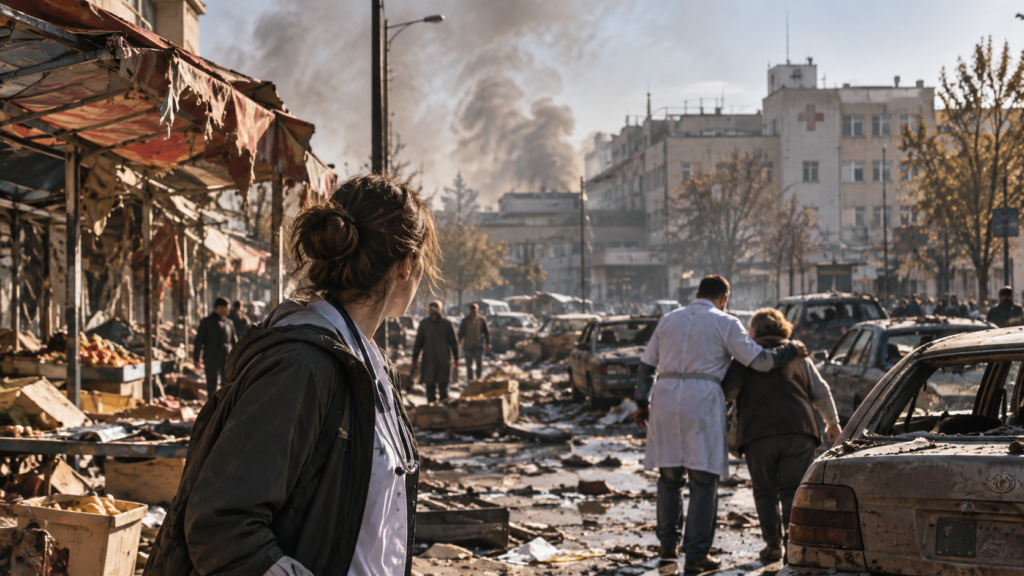
The Institute of Pathology was marked with the Red Cross under the international conventions. According to the account, one bomblet struck the centre of the Institute’s flag. The roof was pierced and the walls were hit by fragments in dozens of places. A fire in the hospital car park destroyed 16 cars and damaged 21. Six Clinical Centre workers were injured. Afterwards, eight unexploded bomblets were found on the car park and the surrounding grass.
In the study’s figures, 15 civilians were killed, 18 were seriously injured and 11 lightly injured in that one cluster bomb attack. All were treated at the Clinical Centre in Niš. Some 120 residential buildings were damaged and 47 destroyed. Five days later, on 12 May, cluster bombs fell on Niš again, this time on its most densely populated districts, including the centre and the Duvanište neighbourhood.
The second container
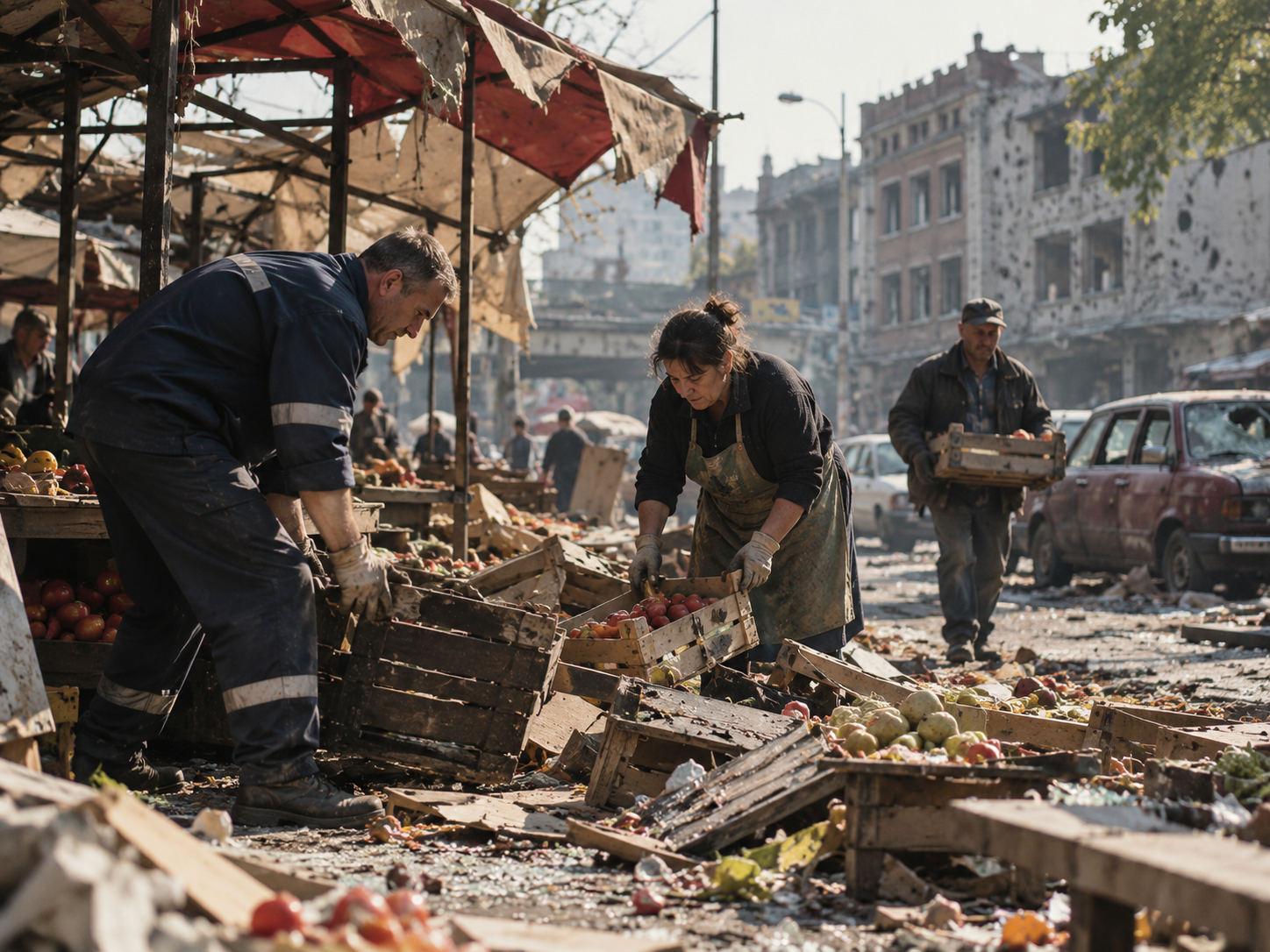
The second container held between 100 and 150 bomblets. It fell on the city centre. It hit the clinic of the “12 Februar” health centre, the central market below the Niš Fortress, the building of the University Rectorate and the apartment blocks around them. People were shopping at the market or walking through the centre. The study records that the fragments caused severe injuries to people at the market and in the streets.
Human Rights Watch’s reconstruction counted 14 civilian deaths and attributed the attack to a container that failed to open over the airfield, NATO’s intended target. The local record adds what that count leaves out: who was hit, where, and with what.
What a cluster bomb does to a body
The most original part of the chapter is medical. It draws on the work of the physicians who treated the wounded, published in 1999, and explains why these injuries were so hard to treat.
A cluster bomblet breaks into irregular fragments that leave the explosion at 1,500 to 2,000 metres per second and lose speed quickly. Their irregular shapes give the wounds a characteristic form. They are mostly through-and-through wounds that tear large blood vessels and nerves and create ideal conditions for infection, especially anaerobic infection. As a fragment passes through tissue, it throws the tissue forward, sideways and back. For a high-velocity fragment this forms a temporary cavity 30 to 40 times its own size, with pressures of up to 100 atmospheres. The cavity lasts milliseconds. Its pulsation draws air and dirt into the wound. The entry hole may be only one or two centimetres across while the damage around the track extends for several centimetres. Bone, muscle and solid organs suffer most.
The blast wave travels through air at about 3,000 metres per second. Where it meets the lungs, it can tear the walls of the air sacs. The study notes that this complication may appear only 12 or more hours later. A patient may show nothing more than a little blood when coughing, a bluish tinge or unusual behaviour. In the abdomen, the same wave can rupture organs that contain air.
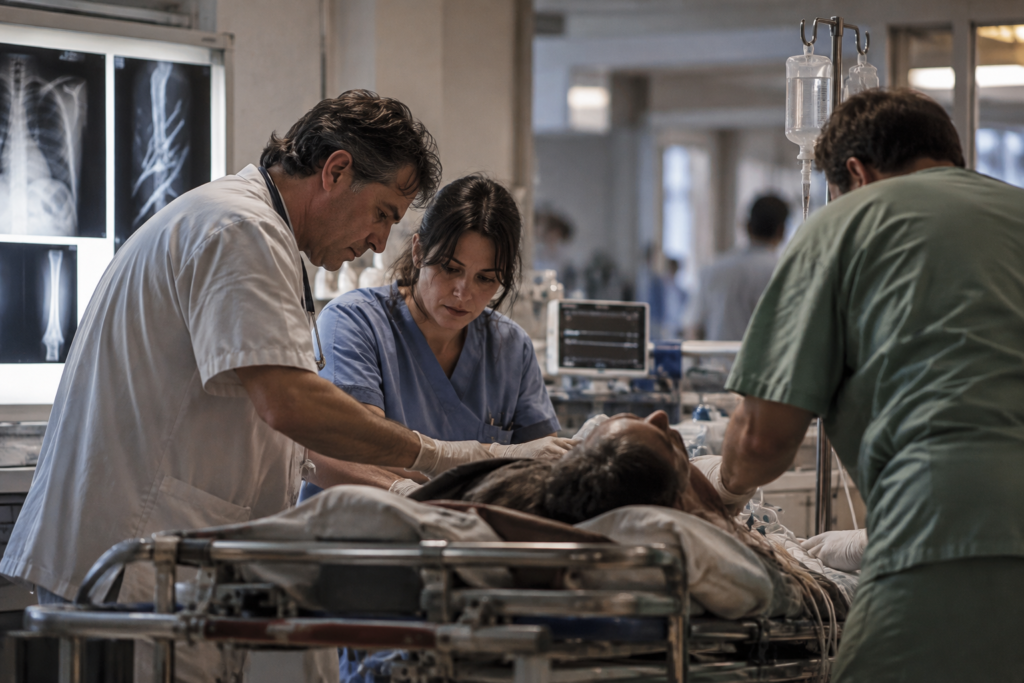
Treating such patients took a team: a general surgeon, an orthopaedist and a plastic surgeon working together. Even so, the study records, many were left with lasting consequences, from functional disability to the loss of limbs.
A weapon that misses in hundreds of places
The study places Niš in a wider count. More than sixty containers of cluster bombs fell on the Federal Republic of Yugoslavia, each holding about 240 bomblets on average, roughly 15,000 in all. The book’s conclusion, drawing on the 1999 work of the Niš doctors Golubović and colleagues, is that using cluster munitions against civilian targets, as in Niš, was “extremely inhumane and contrary to the norms of civilisation” (translated).
International law later moved in the same direction. In 2000, a committee advising the Yugoslav tribunal’s prosecutor found no treaty that then banned cluster bombs and recommended no investigation. In 2008 the Convention on Cluster Munitions banned them for the states that join it. Serbia has not joined. It is still clearing the last known areas of contamination from 1999.
The campaign’s longest tail, depleted uranium, is the subject of Cancer in Serbia After 1999: What the Registry Shows and What the Tissue Shows. The long life of war damage is traced in The Fire Does Not Stop at the Border.
Twenty-seven years on, the record kept by the doctors of Niš is still the most exact account of what one cluster bomb attack did to a city: a flag pierced at its centre, eight bomblets in the grass, and wounds that kept hurting long after the planes had gone.
Frequently asked questions
Was the hospital in Niš hit by cluster bombs?
Yes. The Institute of Pathology of the Clinical Centre, marked with the Red Cross, was hit; six staff were injured and 16 cars burned in the hospital car park, according to the record in Projektili pravde.
What injuries do cluster bomb fragments cause?
Irregular fragments at 1,500–2,000 m/s cause through-wounds that tear vessels and nerves, a temporary cavity up to 40 times their size, contamination and, from the blast, lung damage that may appear 12 or more hours later.
How many cluster bombs were dropped on Yugoslavia in 1999?
Projektili pravde estimates more than sixty containers of about 240 bomblets each, roughly 15,000 bomblets in all.
Is Serbia a party to the Convention on Cluster Munitions?
No. The 2008 Convention bans cluster munitions for its members; Serbia has not joined and is still clearing contamination from 1999.
Sources and further reading
S. Aleksić, Projektili pravde (Niš, 2024), ch. 2, citing Golubović et al. (1999) and Bošnjaković (1999)
Human Rights Watch, Civilian Deaths in the NATO Air Campaign (2000)
ICTY, Final report of the committee reviewing the NATO bombing campaign (2000)