The Dust After the Strikes on Doha and Dubai
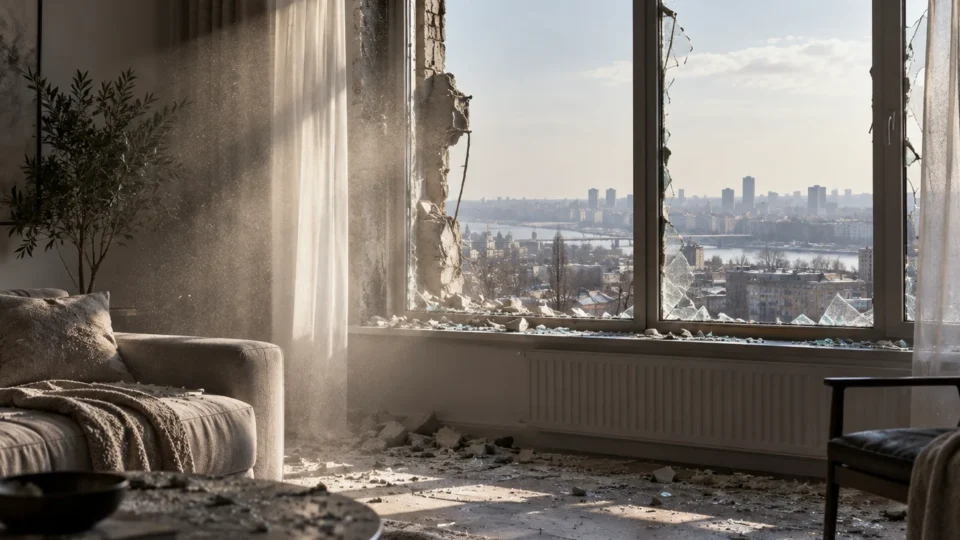
Missiles, drones and the fragments of interceptors have fallen on Doha and Dubai. A gas complex, an airport's fuel tanks, a port and industrial plants have burned. Srđan Aleksić on what that smoke and dust can contain, what the Balkans learned about it too late, and what the people of the Gulf should do now.

Srđan Aleksić represents claimants in Serbian proceedings concerning depleted uranium.
The Short Answer
Toxic dust from missile strikes and burning plants can carry fine particles, metals and combustion products; particles of 2.5 microns and smaller are classed as carcinogens of the first class, as Projektili pravde (2024) notes. Doctors cited in the book put the latency at 5–10 years for blood cancers and 15–20 for solid tumours. No measurements around Doha or Dubai have been published.
In the spring of 2026 the people of Doha and Dubai learned a sound the people of Niš and Vranje learned in 1999. First the siren, then the flash, then a smell that stays in the street for days.
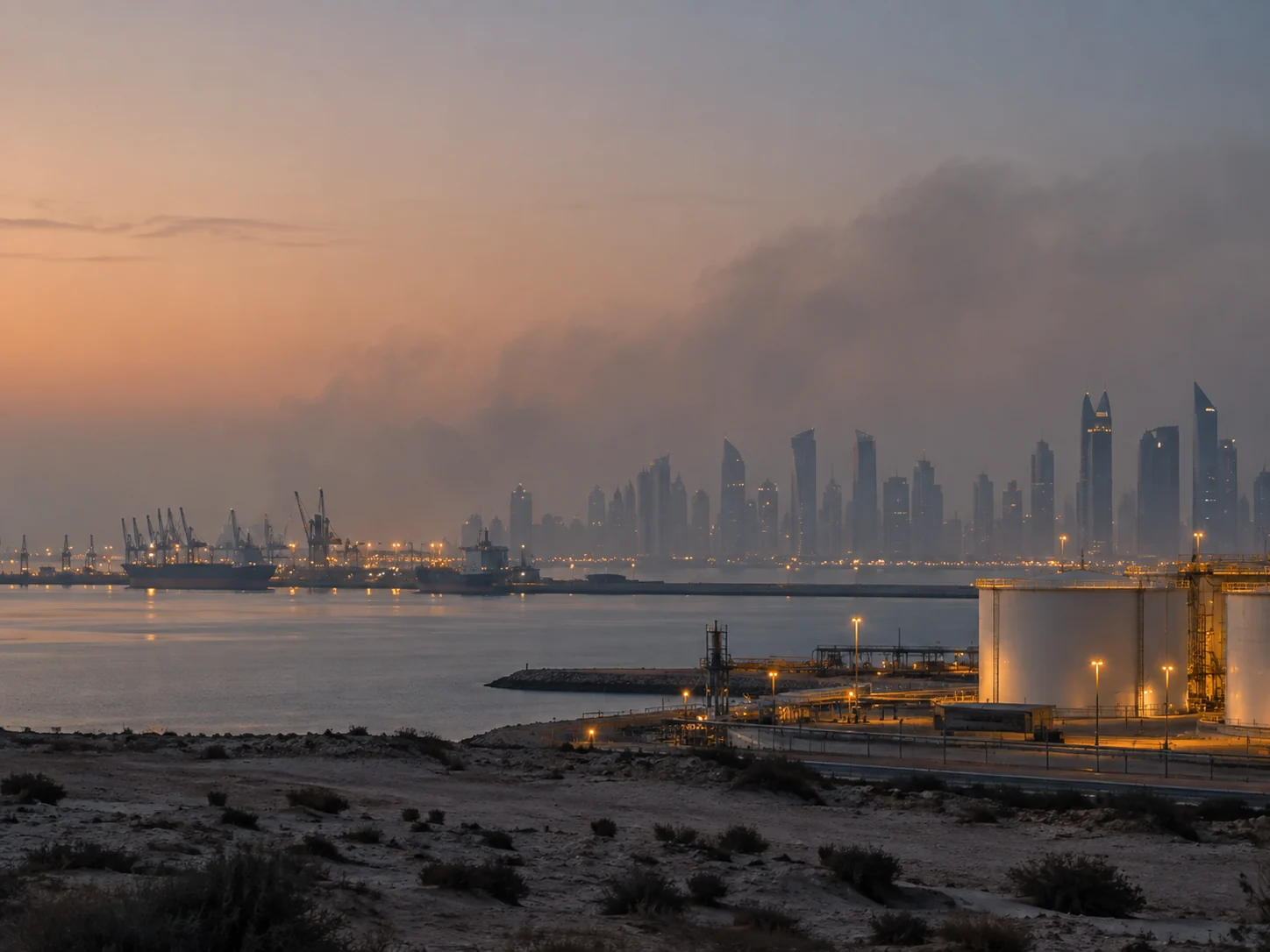
What fell was not one thing. Iranian missiles and drones. The fragments of the missiles fired to stop them. And then the fires: at Ras Laffan, Qatar’s gas export hub, on 18 March; at the fuel tanks of Dubai’s airport on 16 March; at Jebel Ali port; at refinery and aluminium plants elsewhere in the Emirates, as our report on the strikes set out. The toxic dust from these missile strikes is not a single substance. It is everything that burned, broke and fell.
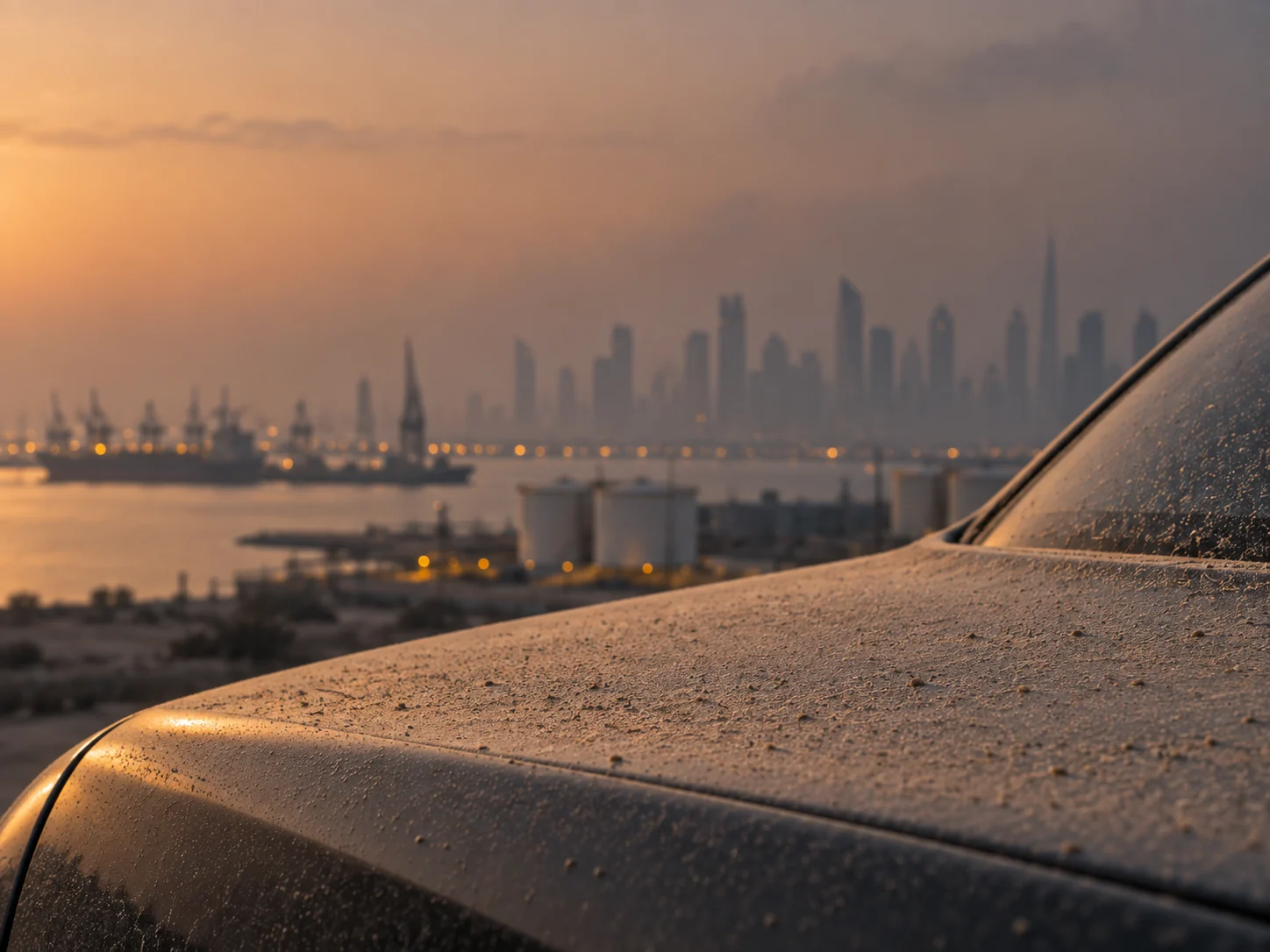
What the smoke from a burning industrial site can contain
We have seen this before. When the chemical complex at Pančevo burned in April 1999, the statement of claim in an Italian soldier’s case, reproduced in Projektili pravde, my 2024 study of the bombing, listed what it said escaped: chlorine gas, hydrochloric acid, mercury, vinyl chloride, and PCBs and dioxins from destroyed transformers. Twenty-five years later the book can only record that the quantities are impossible to determine, because nobody measured them on the day.
A gas plant is not a petrochemical plant, and an aluminium smelter is not a refinery. But each fire releases fine particles, and the fine particles are the danger that does not announce itself. The book cites the conclusion of the World Health Organization’s cancer agency that airborne particles of 2.5 microns and smaller are carcinogens of the first class. Particles of that size go deep into the lung. Where they settle and travel, the book notes, decides where the disease appears.
Metal is the second danger. Missiles and interceptors are made of it, and they burst over cities. In judgment 6465/2022, cited in the book, Italy’s Council of State overturned a lower court that had ignored a laboratory finding: nanoparticles of heavy metals of various types inside a soldier’s tumour tissue. Italian courts have treated that kind of finding as evidence. The Gulf should treat it as a warning.
The Gulf already has uranium in its sand
This is the part the Gulf rarely discusses. The book records that during the first Gulf war about 300 tonnes of depleted uranium ammunition were used in the attack on the Iraqi armoured division guarding the approach to Baghdad. The region’s first uranium is thirty-five years old, and it did not leave. Dust in this region moves with the wind across every border, as the smoke of Kuwait’s burning wells did in 1991, described in The Fire Does Not Stop at the Border.
No use of depleted uranium has been reported in the 2026 strikes on Qatar or the Emirates, and I do not claim one. The point is different. The Gulf now carries two layers of toxic dust: an old uranium layer from 1991 and a new layer of industrial smoke and metal from 2026. Nobody has published measurements of either around Doha and Dubai.
| Source of toxic dust | What it can release | When illness may appear | What to keep now |
|---|---|---|---|
| Burning gas, fuel and refinery plants | Fine particles; combustion products; in chemical plants, chlorine compounds, mercury, dioxins | Blood cancers 5–10 years; solid tumours 15–20 years (doctors cited in Projektili pravde) | Dates and places you were near the fire; employer’s records |
| Exploded missiles and interceptors | Metal fragments and metal dust | Same latency; metals can accumulate in tissue | Photographs; where debris fell; who cleared it |
| Old battlefields of 1991 | Depleted uranium dust that wind can lift again | Decades | Where you lived and worked; food grown locally |
Who will fall ill, and where
The doctors whose work the book collects put the latency plainly: blood cancers five to ten years after exposure, solid tumours of the lung or bowel fifteen to twenty. Most of the people who lived and worked through the strikes on Doha and Dubai are foreign workers. By the time any illness appears, many of them will be home in India, Pakistan, Bangladesh, Nepal or Africa, far from the place that made them sick and from the records that could prove it.
That is how a cancer epidemic caused by toxic dust becomes invisible. Not because it does not happen, but because it happens in a thousand villages, years later, to people nobody counted.
What to do now
The book sets out what a court will need before it accepts that an exposure caused an illness. Adapted to the Gulf, it is a checklist. Establish where, when and in what circumstances the strike happened, with witness statements. Measure radioactivity and contamination at the site and in nearby water. Map every person who falls ill and check whether they were exposed in the attack, lived at the site later, or ate food grown near it. Check every official report on what was done with the soil, the debris and the burned vehicles. If a government does not do this, the people concerned must at least keep their own record: dates, places, employer, medical files, and the tissue from any biopsy, which can still be analysed years later, as our report on the tissue evidence showed.
What my research taught me
Everything I have studied about 1999 points to one conclusion: the people who breathe toxic dust are not powerless, provided someone writes the record while it can still be written. That is the method I have developed with my colleagues in Serbia and Italy. Document the exposure. Preserve the tissue. Then hold to account the party that sent you there or had the duty to protect you, under the Italian standard of more probable than not. It has worked for soldiers in Italian courts more than 300 times. It can work just as well for a welder at Ras Laffan or a waiter in Dubai. Justice does not need to know your nationality. It needs your record. How my work can help is set out on my page at Legal Smart.
How a claim can be made
There are three doors. The employer, who sent a worker to a site it knew was dangerous. The state of residence, which has a duty to protect people from risks it knew about, as I argued in The Last Address of Responsibility. And the home state, which can raise a claim for its citizens with another state. After Kuwait, the UN created a commission that paid even migrant workers. That happened once. Whether it happens again depends on whether the record exists.
The war will end. The toxic dust will settle into lungs, soil and water, and the question will be asked in ten years. It will be answered by what is written down this year.